
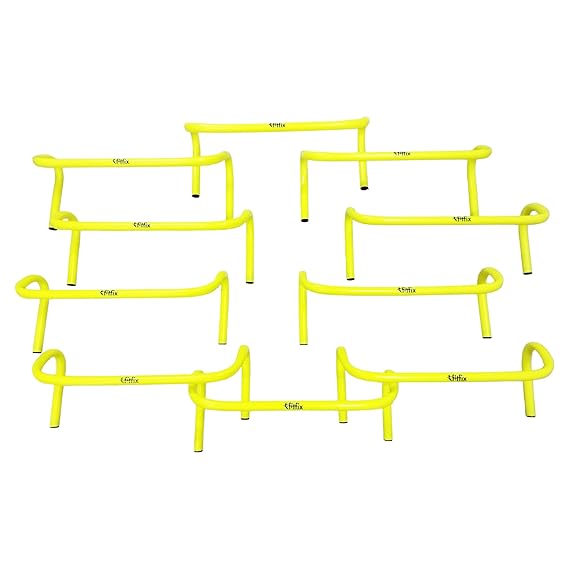
Easy Setup Hurdle for Convenience Ideal for Multiple Sports :- Designed for hassle-free assembly and fixed height, allowing users to focus on their training without disruptions. Whether it’s cricket, football, or general fitness training, Fitfix Hurdles are versatile and suitable for a wide range of sports applications and daily workout.
Fitfix® Training Hurdles for Field Training and Speed Coordination ! Hurdles for Kids Occupational Therapy 6,9,12 Inch Agility Hurdles (6.0 Inches, Qty 10 Pcs)
Original price was: ₹3,499.00.₹1,649.00Current price is: ₹1,649.00.
Description
Speed Coordination
A Comprehensive Exploration
Speed coordination is a fundamental athletic quality combining rapid movement with precise control. It underpins success in many sports: sprinting, team sports, martial arts, gymnastics, dance, obstacle course racing, and more. This text explores what speed coordination is, how it works, how it can be trained, measured, its importance, and how it interacts with other athletic qualities.
1. Definition & Core Concepts
1.1 What Is Speed Coordination?
-
Speed refers to how fast someone can move — either in terms of whole‑body displacement (e.g. sprinting) or in rapid movements of limbs (e.g. dribbling, punching).
-
Coordination refers to the ability to use different body parts smoothly and efficiently together. It involves timing, spatial awareness, balance, and motor control.
-
Combining them, speed coordination is the capacity to execute fast movements with precision, minimal wasted motion, high accuracy, and stable form. It is not just “be fast,” but “be fast and controlled.”
1.2 Components of Speed Coordination
To understand speed coordination, it helps to break it down into constituent elements:
-
Neural control: fast signal transmission, efficient motor unit recruitment, proper inter‑muscular coordination (how different muscle groups work together) and intra‑muscular coordination (within muscles), reflexes.
-
Muscle mechanics: fast twitch fiber utilization, muscle stiffness, elasticity (stretch‑shortening cycle), tendon stiffness, force generation speed.
-
Biomechanics and technique: optimal joint angles, limb trajectories, posture, minimizing drag or resistances, efficient strides or swing paths.
-
Perception and anticipation: ability to see (or sense) what’s coming and react quickly; spatial awareness; pattern recognition.
-
Balance, stability, and control: core stability; control of the center of mass; ability to maintain form under changing loads and directions.
-
Flexibility / mobility: joint mobility allows efficient motion arcs; flexibility helps reduce resistance and prevent injuries.
2. Why Speed Coordination Matters
2.1 Performance Enhancement
-
In sprints, not just how many strides per second, but how well you place your foot, arm swing, torso alignment, etc. Good coordination improves efficiency, reduces energy waste, improves velocity.
-
In sports like soccer, basketball, tennis, or martial arts, speed coordination enables quick changes of direction, feints, reacting to opponent, combining multiple movements (jump + twist + turn + acceleration).
2.2 Injury Prevention
-
Poor coordination leads to inefficient movement, overcompensation, imbalanced loads. That increases risk of strains, sprains, joint injuries.
-
Proper coordination ensures safe limb positions, reduces stress on joints, muscles, tendons.
2.3 Transfer & Versatility
-
Transfer to multiple skills: high coordination means learning new motor skills more rapidly.
-
Helps in agility, acceleration, deceleration, change of direction, reactive movements.
2.4 Lifelong Movement Quality
-
Even outside of sport: better coordination helps in everyday tasks (lifting, bending, avoiding falls), in occupational settings, in aging.
3. Physiological & Neurological Foundations
3.1 Motor Units & Muscle Fiber Types
-
Type II (fast twitch) fibers are important for high speed movement; their recruitment must be optimized via training.
-
Motor unit recruitment order, synchronization, and firing frequency affect how fast and forcefully muscles contract.
3.2 Neural Pathways & Reaction Time
-
Central nervous system: brain (motor cortex, cerebellum), spinal cord reflex arcs.
-
Peripheral nerves: speed of stimulus transmission.
-
Reaction time (stimulus to initiation) and movement time (initiation to completion). Anticipation, pattern recognition can reduce reaction delays.
3.3 Stretch‑Shortening Cycle (SSC) & Elastic Energy
-
Muscle‑tendon complex stores elastic energy during an eccentric (lengthening) phase, then recoils in concentric (shortening) phase. Example: plyometrics, tendon “springiness,” improving SSC efficiency improves speed coordination.
3.4 Proprioception, Kinesthetic Awareness & Feedback
-
Proprioceptors in muscles, tendons, joints provide feedback: position, movement, force.
-
Kinesthetic awareness: the internal sense of body position and movement.
-
Visual feedback, auditory feedback, tactile feedback also important.
4. Biomechanics & Movement Technique
4.1 Efficient Movement Patterns
-
Optimal joint angles at hip, knee, ankle in running or sprinting; shoulder and trunk angles.
-
Movement economy: reduce unnecessary motion, especially of non‑propulsive parts (e.g. torso twist, swinging limbs excessively).
4.2 Stride Mechanics & Foot Strike
-
Stride length vs. stride frequency: balance to maximize speed without sacrificing control.
-
Foot strike position: over‑stride causes braking; under‑stride limits propulsion.
4.3 Upper Body & Arm Action
-
Proper arm swing supports balance and counters rotational torques.
-
Coordination between arm and leg movement for rhythm, symmetry, energy conservation.
4.4 Ground Contact & Force Application
-
Time of contact, force magnitude, direction of push.
-
Reactive strength: ability to push off quickly and effectively.
5. Training Speed Coordination
5.1 Warm‑Up & Mobility Work
-
Joint mobility drills: hips, ankles, shoulders.
-
Dynamic stretching to prepare muscles for fast contractions.
-
Neuromuscular activation drills (skips, bounding) to wake up the nervous system.
5.2 Drills for Speed Coordination
Here are various drills and exercises focusing on speed coordination:
| Drill | Purpose / What It Trains |
|---|---|
| High‑Knee Running / Skipping | Enhances knee drive, leg turnover, coordination between upper & lower body. |
| Carioca & Ladder Drills | Lateral movement, foot placement, agility, rhythm. |
| Bounding & Hops | Develops SSC, ground contact, elasticity, power coordination. |
| Resisted Sprints / Runs | Resistance (sleds, parachutes, bands) slows movement so the nervous system adapts to higher demand. |
| Overspeed Training | Slight downhill sprints, towing, to get used to higher turnover rates (carefully). |
| Change‑of‑Direction Drills | Shuttle runs, T‑drills; improve deceleration + acceleration + coordination. |
| Plyometrics (box jumps, depth jumps) | Builds reactive strength, fast power, and coordination between eccentric‑to‑concentric transitions. |
| Complex Moves / Sport Specific Skills | Combining cuts, feints, jumps, throws – sport‑relevant skills to train speed coordination in context. |
5.3 Integrating Speed & Strength Training
-
Strength training improves force production: squats, deadlifts, lunges, single‑leg work.
-
Power training: Olympic lifts, jump squats, cleans.
-
Coordinated strength: unilateral work helps balance sides; core strength helps stabilize during high speed movement.
5.4 Neuromuscular Training
-
Drills for reaction and perception, e.g. reacting to visual or auditory cues.
-
Balance & proprioceptive work: balance boards, unstable surfaces to force control.
-
Technique drills with video feedback or coaching to refine movement patterns.
5.5 Periodization
-
Plan phases: base (technique, strength), build (speed drills, volume), peak (max speed, specificity), taper, maintenance.
-
Recovery is crucial: speed coordination demands fresh neural capacity. Fatigue degrades coordination and increases injury risk.
6. Measuring & Monitoring Speed Coordination
6.1 Quantitative Metrics
-
Sprint times (10m, 20m, 30m, etc.). Acceleration phases show ability to coordinate force quickly.
-
Stride frequency and stride length, measured via video or sensors.
-
Ground contact time and flight time (in running/jumping). Short ground contact implies more reactive, better coordination.
-
Reactive strength index (RSI): jump height divided by contact time.
-
Change of direction speed (COD speed): time to change direction in standard drills.
6.2 Qualitative Observation
-
Symmetry: e.g. are left and right sides mirroring well?
-
Rhythm / fluidity: are movements stuttered, jerky, or smooth?
-
Posture and alignment: trunk lean, foot placement under balance, arm swing.
6.3 Technology Tools
-
Video analysis: motion capture, slow mo to observe joint angles, limb motion.
-
Wearables: accelerometers, GPS, gyroscopes to capture turnover, contact time, velocities.
-
Force plates: ground reaction forces, balance.
7. Influencing Factors & Constraints
7.1 Age, Maturation & Development
-
Children and adolescents have less matured neuromuscular systems; coordination tends to improve with age and training.
-
Growth spurts temporarily disrupt coordination.
7.2 Genetic Predispositions & Muscle Fiber Type
-
Some people have more fast‑twitch fibers; others are more naturally coordinated.
-
Tendon stiffness, limb length, lever arms all influence potential.
7.3 Fatigue & Recovery
-
Fatigue impairs coordination: slower reaction, sloppy technique, higher error rates.
-
Recovery (sleep, nutrition) is essential to maintain neural readiness.
7.4 Environmental & Equipment Constraints
-
Surface type (track, grass, sand) influences movement speed and coordination.
-
Footwear matters: shoes with grip, cushioning, flexibility.
-
Weather: wet surfaces, wind, temperature can affect performance.
7.5 Psychological & Cognitive Factors
-
Focus, attention, motivation, mindset.
-
Anticipation, decision making under pressure.
8. Examples in Different Sports
Looking at how speed coordination manifests in different sports helps clarify its application.
8.1 Sprinters & Track Athletes
-
Maximum acceleration phase: need powerful, coordinated hip, knee, ankle motions.
-
Transition to top speed: minimizing vertical oscillation, efficient arm‑leg coordination.
-
Maintaining technique under fatigue.
8.2 Team Sports (Soccer, Basketball, Rugby)
-
Quick cuts and direction changes; reacting to opponents or ball.
-
Dribbling, passing while moving, quick transitions offense/defense.
-
Sprinting, decelerating, reaccelerating repeatedly.
8.3 Racquet Sports (Tennis, Badminton)
-
Footwork: rapid small steps, lateral and diagonal movement, pivoting.
-
Hand‑eye coordination with racket: hitting accurately while moving.
-
Split step, anticipating opponent’s direction.
8.4 Combat Sports / Martial Arts
-
Combining punches/kicks with footwork; avoiding strikes; moving in and out quickly.
-
Rhythm, timing, maintaining balance during strikes.
8.5 Dance, Gymnastics & Acrobatics
-
Very high coordination demands: flips, spins, leaps, transitions.
-
Need fine control over whole body, rhythm, space awareness.
9. Training Programs & Sample Session
Here is a sample training session focused on speed coordination, plus program structure.
9.1 Weekly Program Structure (Example)
| Day | Focus |
|---|---|
| Day 1 | Technique + Speed Drills + Acceleration Work |
| Day 2 | Strength + Plyometrics + Mobility |
| Day 3 | Rest or Active Recovery (light coordination drills) |
| Day 4 | Change‑of‑Direction + Reaction + Sport‑Specific Speed |
| Day 5 | Max Speed Work + Overspeed / Resisted Sprints |
| Day 6 | Endurance / Conditioning + Movement Quality |
| Day 7 | Rest or Low Intensity Coordination Games |
9.2 Sample Session (≈90 minutes)
-
Warm‑Up (15 min)
• Dynamic movements: leg swings, hip openers, ankle rolls.
• Mobility: hip flexors, hamstrings, ankles.
• Neuromuscular activations: skipping, high knees, butt kicks. -
Technique Drills (15 min)
• A‑skips, B‑skips, straight‑leg bounds.
• Ladder drills: quick feet, in‑out, lateral crossovers.
• Carioca, side shuffles. -
Speed / Acceleration Work (15 min)
• Short sprints: 10‑20m from various starts (standing, falling start).
• Resisted sprints (parachute, sled).
• Overspeed work (gentle downhill, or elastic towing). -
Change‑of‑Direction & Reaction (10 min)
• T‑drill, shuttle runs.
• Partner‑cue reaction drills: partner gives visual cue to sprint left/right.
• Cone drills with random patterns. -
Plyometrics & Power (10 min)
• Box jumps, depth jumps.
• Single‑leg hops.
• Bounding. -
Sport‑Specific Integration (15 min)
• Simulated movements from your sport: cuts, pivots, transitions, ball drills or shadow work.
• Combine speed + coordination under sport demands: e.g. sprint + change direction + execute skill. -
Cooldown & Recovery (10 min)
• Static stretching; foam rolling.
• Light mobility and breathing work.
10. Challenges & Common Mistakes
-
Overtraining speed drills without sufficient rest → degraded coordination, injury risk.
-
Neglecting technique under fatigue; sloppy form becomes automatic.
-
Poor joint mobility blocking proper form; e.g. stiff ankles causing over‑compensation elsewhere.
-
One‑sided training: asymmetries (one leg, one arm) lead to imbalance.
-
Ignoring the cognitive/reactive component; training only planned drills but not unplanned or game‑like situations.
11. How to Progress & Adapt
11.1 Gradual Increase
-
Gradually increase intensity, complexity, or speed of drills. Introduce more reactive, unplanned stimuli.
-
Increase resisted or overspeed work with care.
11.2 Variation
-
Vary drills (direction, surfaces, angles) so coordination becomes adaptable.
-
Vary environmental conditions (slight slope, different surfaces, mild distractions) to build robustness.
11.3 Individualization
-
Tailor to the athlete’s strengths and weaknesses: someone with weak COD skills may focus more there; someone with poor reactive ability may add more reaction drills.
-
Take into account age, training status, injury history.
12. Monitoring Progress & Feedback
-
Use objective measurements: sprint times, COD times, RSI, ground contact times.
-
Video feedback: record athletes and show joint angles, posture, technique.
-
Use coach feedback, peer feedback, and self‑awareness of movement quality.
-
Keep training logs: noting performance, fatigue, errors.
13. Interaction with Other Athletic Qualities
Speed coordination doesn’t exist in isolation. It interacts with:
-
Strength & Power: Force production is the base; coordination helps apply force effectively and in correct directions.
-
Agility: Combination of speed coordination + decision making + balance.
-
Flexibility / Mobility: Without adequate mobility, coordination is limited.
-
Endurance & Conditioning: As fatigue builds, coordination tends to degrade; endurance is needed to sustain good coordination.
-
Flexibility / Joint Health: Proper mobility allows coordination to work across full ranges.
14. Case Studies & Examples
14.1 Elite Sprinter
-
Works with technical coaches to refine foot strike, arm swing, knee lift.
-
Uses high‑speed video, motion capture to optimize stride.
-
Plyometrics and reactive drills to improve SSC.
-
Very careful about rest and neural recovery.
14.2 Football (Soccer) Winger
-
Needs rapid acceleration from static, abrupt changes of direction, dribbling while at speed.
-
Practices drills with the ball plus agility ladders, cones, reactive partners.
-
Work both on planned patterns and unpredictable situations (defender reads, reaction).
14.3 Martial Artist
-
Needs coordination of fast arms, legs, evasion, feints.
-
Combines speed drills, shadow boxing, pad work, reaction training.
-
Balance, core stability, joint mobility critically important.
15. Trends & Research Directions
-
Wearable technology continues to improve in capturing fine metrics: accelerometers, gyroscopes, muscle sensors, real‑time feedback.
-
Neuroscience applications: brain training; enhancing reaction, decision making via cognitive drills.
-
Motor learning theories: internal vs external focus, block vs random practice, visualization.
-
Artificial Intelligence & Machine Learning: analyzing motion, giving personalized feedback, optimizing drills.
-
Injury prevention research: how to detect coordination breakdown early and correct.
16. Summary & Practical Takeaways
-
Speed coordination = speed + precision + control.
-
It involves neural, muscular, biomechanical, perceptual, and psychological components.
-
Training requires a mix of drills (planned, reactive, sport‑specific), strength/power, mobility, rest.
-
Measurement and feedback help refine it.
-
Must be tailored to individual, sport, environment.
-
Over time, well‑developed speed coordination enhances performance, reduces injury risk, and increases movement efficiency.
Only logged in customers who have purchased this product may leave a review.
Reviews
There are no reviews yet.